Total Cost of Ownership (TCO) – The 5 Key Components
5 Hidden Costs That Prove the Cheapest Price Tag Is a Lie
We've all been there. You buy the budget-friendly power drill for a weekend project, only for it to break after the third screw. You end up buying the more expensive, reliable model anyway, and now you've paid for one tool twice. That initial "bargain" was anything but.
This same principle applies to professional procurement, but on a much larger and more costly scale. The allure of the lowest price tag can mask a web of downstream expenses that ultimately make a "deal" far more expensive than a higher-priced alternative.
To navigate this, you use a framework called Total Cost of Ownership (TCO). In simple terms, TCO is a strategic approach that goes beyond the initial purchase price and evaluates the entire cost of acquiring, operating, and disposing of a product or service.
This requires looking beyond the supplier's quote and collaborating with the people who will actually use, handle, and dispose of the product:
- your internal users,
- warehousing staff, and
- operations teams.
This article uncovers the five core cost categories that reveal the true value of a purchase. While traditional analysis focuses on the obvious, it often misses the most critical modern factors: risk and sustainability.
Watch the Video Below for a Quick Understanding of How TCO Affects Purchasing Decision, Before Continuing Below.
How Does Total Cost of Ownership/TCO Compares to Price?
Price is What You Pay to Buy Goods/Services
Total Cost is What You Pay to Buy, Up-Keep & Use Goods/Services
The Old TCO Framework!
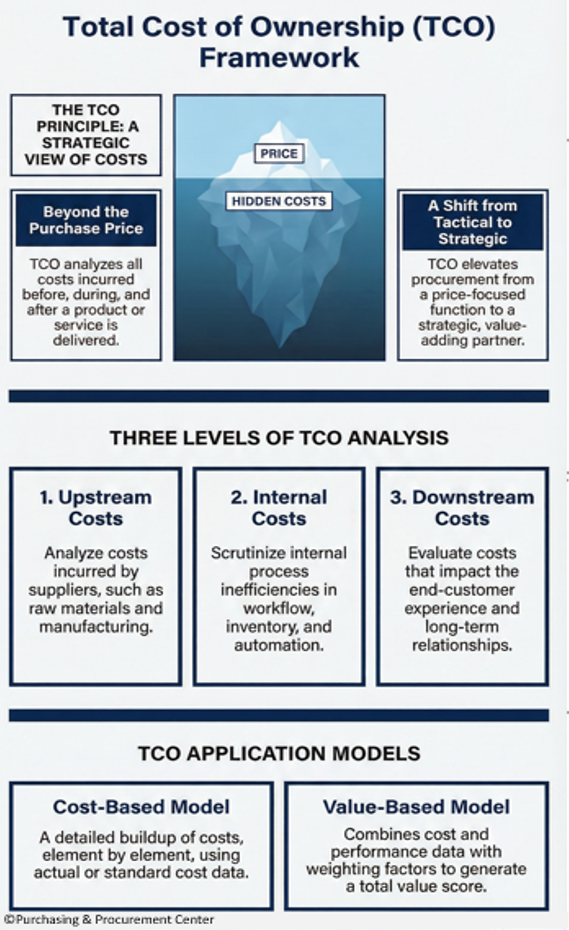
The New TCO Framework Includes 5 Components, not 3:
- Acquisition Costs: The Tip of the Iceberg
- Operating Costs: The Price of Daily Use
- The Cost of Uncertainty: Quantifying and Mitigating Risk
- Environmental & ESG Costs: The Price of Your Values
- End-of-Life Costs: Planning for the End at the Beginning
1. Acquisition Costs: The Tip of the Iceberg
Acquisition costs are the most visible expenses and include everything needed to get a product in the door. While they are the easiest to calculate, overemphasizing them leads to overlooking significant downstream operational inefficiencies.
This category covers:
- The unit price
- Transport and delivery fees
- Initial setup, installation, or training
Think of it like owning a car. The sticker price is the Acquisition Cost.
But to understand the true expense, you must also account for the ongoing Operating Costs for fuel, insurance, and maintenance.
Finally, the trade-in or disposal process represents the End-of-Life Cost. A business purchase is no different; a low initial price is merely the tip of the iceberg.
2. Operating Costs: The Price of Daily Use
Operating costs are the ongoing expenses required to keep a product or service functional. A product with high usage costs, even if purchased cheaply may cost significantly more over its lifetime.
These costs include everything from energy consumption and routine maintenance to consumables like ink or filters and the labor needed for operation.
A perfect example of hidden operating costs is the operational impact of packaging. Imagine you're printing thousands of promotional flyers.
Supplier A’s higher quote includes delivery in clearly labeled, easy-to-handle boxes. The cheaper Supplier B delivers the flyers in bulk on a single, shrink-wrapped pallet.
Supplier B's method creates significant downstream costs: their bulk packaging requires costly manual handling, sorting, additional storage space, and can even introduce health and safety risks for your team. To uncover these costs, you must ask deeper questions:
- How are the items packaged? (Ask your warehouse and operations teams.)
- What’s the cost of storage based on the packaging method?
- Are there hidden labor costs involved in handling the shipment?
This is a classic TCO trade-off, where a higher acquisition cost from Supplier A leads to a lower total cost by eliminating downstream operational friction.
3. The Cost of Uncertainty: Quantifying and Mitigating Risk
Modern TCO analysis must quantify the financial impact of potential problems. These risk-related costs are among the most frequently ignored but highest-impact categories, representing the "what if" scenarios that can derail budgets and timelines.
Specific risks to consider include:
- Supply delays
- Quality failures
- Vendor insolvency
- Warranty issues
Let’s return to the flyer example.
Supplier B offers a quote that's 10% cheaper, but their history suggests a risk of delays that could jeopardize your marketing campaign launch.
That potential delay has a real financial cost:
- lost sales, wasted ad spend, and damage to your brand's reputation.
In a formal analysis, this can be quantified with a simple formula:
Impact ($) × likelihood (%).
This is another classic TCO trade-off: a 10% reduction in acquisition cost can be wiped out by a single high-impact supply chain failure.
4. Environmental & ESG Costs: The Price of Your Values
TCO is evolving to include Environmental, Social, and Governance (ESG) costs, reflecting a company's commitment to sustainability. These aren't just feel-good metrics; they have tangible financial implications.
Concrete environmental costs include:
- Carbon Footprint: The cost to offset CO2 emissions from manufacturing and shipping.
- Waste Disposal: Fees associated with non-recyclable packaging or hazardous materials.
- Regulatory Fines: Penalties for failing to meet environmental standards.
The choice between a local and an offshore supplier for printing flyers provides a clear example of this trade-off.
5. End-of-Life Costs: Planning for the End at the Beginning
What happens when a product is no longer needed?
This question is often forgotten during purchasing, but the expenses associated with disposing, recycling, or retiring an asset can be significant.
Examples of these end-of-life costs include:
- Decommissioning costs for large equipment
- Environmental disposal fees for electronics or batteries
- Contract termination or switching fees
Ignoring these costs is a common mistake that can lead to unexpected and substantial charges down the line. Failing to plan for the proper disposal of IT assets or industrial machinery can result in steep regulatory penalties. Planning for the end at the beginning ensures the final bill doesn't come as a surprise.
TCO presentation in the Boardroom
By looking at all the 5 TCO factors you show to the CEO and CFO and any other CXOs that:
First, You're not an order taker but a true Strategic Leader.
Second, that as a Strategic leader you do not talk bullshit but show with facts and data that TCO is about 'Tradeables'.
It's almost never about a 'this or that is the right decision' but it is:
If we do this, we have to live with that!
The Most Valuable Cost Data Isn't in Your Financials!
Some of the most critical cost data isn't found in supplier quotes or financial reports. It comes from talking to the internal stakeholders who interact with the product or service every day.
Interviewing internal users, warehousing teams, and operations staff is essential to uncover costs that are invisible on a spreadsheet.
These conversations are where you discover the real-world probability of quality failures (Risk Cost) and the true burden of handling non-recyclable packaging (ESG Cost). For example:
- An item that requires "fragile handling" translates directly to higher labor costs and increased risk of damage.
- A delivery on a "bulk pallet" versus in "small boxes" impacts everything from unloading time and storage space to warehouse health and safety protocols.
These stakeholder insights reveal the true financial and operational impact of a procurement choice, providing the context that a simple price quote lacks.
From Price Chaser to Value Creator
Adopting a Total Cost of Ownership mindset isn't just a cost-saving exercise; it's a strategic realignment that transforms procurement from a tactical cost center into a strategic business partner.
Instead of simply hunting for the lowest price, the focus turns to identifying the best long-term value for the organization.
TCO turns procurement from a price chaser into a value creator.
This approach is essential for sustainable sourcing, managing risk, and building trust. Modern TCO analysis is being accelerated by AI tools that can help structure breakdowns and generate stakeholder questions, but the core strategic thinking remains human-led.
To put these ideas into practice, you can follow a clear, actionable roadmap, showcased below.
The 6-Step TCO Decision-Making Framework
1. Gather Baseline Data:
Start by collecting quotes and technical specifications from suppliers to establish your initial acquisition costs.
2. Break Down the Lifecycle:
Structure your analysis by mapping out all potential acquisition, operating, and end-of-life costs.
3. Interview Stakeholders:
This is the crucial step for uncovering hidden costs. Talk to your operations, warehousing, and finance teams about usage patterns, storage needs, and potential risks.
4. Quantify the Costs:
Assign an estimated financial impact to each cost component you've identified across the entire lifecycle.
5. Compare Holistically:
Analyze the total lifecycle cost for each supplier, looking beyond just the unit price to see the full financial picture.
6. Make a Strategic Decision:
Select the best option by balancing not just total cost, but also risk, ESG alignment, and overall strategic value.
The next time you evaluate a major purchase, what 'hidden' cost will you look for first?
What's Next After Total Cost of Ownership (TCO)?
TCO is only one of the many ways of managing and reducing costs in procurement. To get further mastery of various cost reduction initiative download the Cost Reduction in Purchasing Special E-Report that showcases Effective, Practical & Easy-to-Apply Strategies, Examples & Techniques to Achieve Cost Reduction in Procurement.
Continue your Journey by Reviewing & Downloading any of the Free Resources Below ...
Strategic Sourcing
How to Implement a Strategic Sourcing Plan with an Example of a Step-by-Step Outline!
Procurement Manifesto - Must Read for Procurement Leaders
The Single Concept That Transforms Procurement Getters Into Strategic Buyers & Leads Them to Succeed in Their Procurement Careers!
6 Must Procurement Practices for Strategic Buyers!
Down to Earth & Easy to Read Report Show-Cases Unique Procurement Practices with Unconventional & Hard-Hitting Examples to Help Buyers Move to a Strategic Level
Free 600 Pages Request for Proposal (RFP) Handbook
The Best Request for Proposal Practices, Checklists, Examples & Guidelines to Bullet-Proof Your RFPs. By Michael Asner - Leading Author for RFP Processes!
Fraud in Procurement: Prevention & Detection - Express White Paper!
How Organizations Can Save Revenue, Improve Reputation & Promote an Ethical Workforce by Implementing Key Strategies that are Simple with Little Time & No Money
7 Star Purchasing Report/White Paper
7 Critical Areas of Excellence that Procurement Directors & Executives Need to Embrace for Success!
Out-Negotiating Suppliers
Special Report Shows Strategies to Successfully Negotiate with Suppliers, Get Better Prices & Terms, Without Being a Pain in Their Back!

Return from Total cost of ownership (TCO) to Strategic Cost Management
Return from Total cost of ownership (TCO) to Purchasing Procurement Center Homepage